How Currency Exchange Rates Affect International Travel Costs
You saved for months, booked the flights, mapped out every destination, and then landed to find your money isn't going as far as you expected. That dinner that should have cost thirty dollars is closer to forty-five. This is not bad luck. It's currency, and understanding how it moves is one of the most underused skills in international travel.
~26.04 mid-market
~74.00 interbank
~123.24
Around 3% plus ATM charges
Roughly 0%–0.6%
5%–10% above calculated costs
How do exchange rates actually affect a trip's cost?
Exchange rates set the real price of everything you buy abroad in your own currency, hotels, flights, meals, and shopping, and that price shifts with the market even when the listed local price never changes. The gap between the mid-market rate and what a bank, card, or exchange counter actually gives you (the spread) is a second, separate cost layered on top.
Pay in local currency rather than your home currency whenever a card terminal offers the choice, and compare providers before any large exchange or transfer; these two habits avoid most of the expensive mistakes on this page.
What Is a Currency Exchange Rate, and Why Does It Keep Moving?
At its simplest, a currency exchange rate is the price at which one currency trades for another. Convert UAE Dirhams to Indian Rupees, or Saudi Riyals to Pakistani Rupees, and you're transacting at that rate.
Rates aren't fixed. They move on a web of economic forces running continuously across global markets: central bank interest rate decisions, inflation data, trade balances, political stability, and investor sentiment can push a currency higher or lower within hours. For travelers, that creates a practical problem: the rate you saw last week may not be the one you get today.
The Interbank Rate vs What You Actually Receive
Financial sites and apps mostly quote one number, the interbank or mid-market rate, which is what major banks trade at among themselves in bulk. It's the reference point, not a rate available to individual travelers.
What you receive as a traveler is almost always different. Banks, exchange shops, apps, and airport counters add a margin called a spread, which is how they make money on the conversion. That spread ranges from a fraction of a percent at competitive online providers to several percentage points at an airport kiosk.
Practical example: On the AED-to-INR corridor, the mid-market rate sat near 26.04 rupees per Dirham as of September 11, 2026, while quoted rates at UAE exchange houses ran closer to 25.87–25.92, a gap of roughly 0.2%–0.6% before any transfer fee. An airport counter's spread is typically wider still. Over one trip, or a year of monthly remittances, that difference adds up.
Quick Reference: Key Currency Pairs for Global Travelers
These corridors come up constantly for travelers, expats, GCC workers, and families comparing travel and remittance costs.
How Exchange Rates Directly Affect Your Hotel Costs
Hotel pricing is where exchange rate movement becomes most visible. Properties in popular destinations often list rates in a local or international currency, commonly USD or EUR, while travelers carry money earned in something else entirely.
A Gulf-based traveler earning in AED or SAR booking a European hotel priced in Euros pays a home-currency cost that depends on the EUR/AED or EUR/SAR rate at the time of booking or payment. A room priced at €200 a night might cost AED 790 on a favorable day. If the Euro strengthens before the payment clears, the same room could run AED 840 or more, purely on timing.
Booking in Local Currency vs Your Home Currency
Many booking platforms let you pay in the property's local currency or in your own. This choice matters more than it looks. Selecting your home currency often triggers dynamic currency conversion, which sounds convenient but usually applies a worse rate than your own bank would. Paying in local currency, and letting your bank or card handle the conversion, usually produces a better outcome, especially with a card that carries no foreign transaction fee.
Airfare, Fuel Costs, and the Hidden Currency Dimension of Flights
Airline pricing carries its own currency dimension, though it works differently from hotels. Airlines typically price tickets in the currency of the country where the booking originates and adjust fares for demand, fuel prices, route competition, and timing.
Jet fuel is priced globally in US Dollars. When the Dollar strengthens against other currencies, airlines operating in non-dollar markets face rising costs, and that pressure can eventually show up in international fares. For GCC travelers there's a structural offset: since the AED and SAR are pegged to the Dollar, purchasing power for USD-denominated expenses, including many international airfares, stays comparatively stable.
Booking Flights: Currency and Timing
Paying in a currency weaker than the one you earn can occasionally produce savings, and some frequent international travelers keep multi-currency accounts for exactly this reason. Chasing rates when booking flights carries its own risk, though: rates reverse quickly, and the time spent monitoring them can outweigh the benefit. A reasonable middle ground is staying generally aware of the rate environment and avoiding major purchases during a stretch of unusual weakness in your home currency.
Shopping Abroad: When the Exchange Rate Becomes a Discount or a Penalty
Currency dynamics can turn shopping abroad into a genuine opportunity or an expensive surprise. Destinations where the local currency is weak relative to yours make meals, shopping, transport, and experiences feel more affordable than the sticker price suggests.
The reverse holds just as strongly. A destination with a currency stronger than your own makes ordinary spending feel disproportionately expensive; a coffee in Zurich or a dinner in London regularly surprises travelers used to Gulf or South Asian prices.
The direction of this effect follows the pegged Gulf currencies too. Since the AED and SAR track the US Dollar, and the Bangladeshi Taka traded near 123 to the Dollar as of September 2026, a Gulf-based traveler visiting Dhaka finds everyday local-currency prices, meals, transport, small purchases, converting to a comparatively small Dirham or Riyal figure. The same traveler heading to a Dollar-strong destination sees that relationship reverse, with identical spending habits producing a noticeably larger bill back home.
Credit Cards Abroad: The Exchange Rate You Do Not See
Swipe a foreign card abroad and the exchange rate applied is usually invisible at the moment of purchase. It's set by your card issuer in the background, and the final rate can include a foreign transaction fee stacked on top of the conversion itself.
Standard cards from major banks such as Chase, Wells Fargo, and Bank of America typically charge around 3% on foreign purchases, plus a flat ATM operator fee near $5 on cash withdrawals. On a $3,000 trip, that adds up to roughly $90–$125 in fees alone.
Fintech travel cards close much of that gap. Wise applies a spread of roughly 0.33%–0.57% on major currency pairs with no weekend markup, while Revolut's standard tier offers 0% conversion up to a monthly threshold on weekdays, adding 1% on weekends and 0.5% above the interbank rate once the threshold is passed. On that same $3,000 trip, the fee difference lands closer to $5–$24 rather than $90–$125.
| Payment Method | Typical FX Cost | Best For |
|---|---|---|
| Airport currency counter | Often the widest margin of any option | Emergency small cash needs only |
| Standard bank card | ~3% fee plus a flat ATM charge | General use; check your bank's terms first |
| Fintech travel card (Wise-style) | ~0.33%–0.57%, no weekend markup | Most international spending |
| Fintech travel card (Revolut-style) | 0% weekdays under threshold; 1% weekends | Frequent smaller transactions |
| Online exchange platform | Usually tighter than airport counters | Pre-trip currency purchase |
| ATM at destination | Varies by home and local bank fees | Local cash needs at destination |
Multi-Currency Wallets: A Practical Setup for Frequent Travelers
Anyone crossing borders more than once or twice a year benefits from setting up a multi-currency wallet before the first trip rather than mid-journey. Most fintech travel cards let you hold and convert balances across a dozen or more currencies inside one app, converting at (or near) the mid-market rate the moment you top up, rather than at whatever rate a foreign terminal applies on the day of purchase.
Setting One Up Before You Travel
- Load major currencies ahead of time: convert into the currency of your destination while the rate looks reasonable, instead of waiting until you land.
- Check coverage for less common currencies: not every app supports every currency; confirm your destination's currency is actually included before relying on it.
- Keep a backup card from a different provider: app outages and card blocks happen, usually at inconvenient moments, so a second option avoids being stranded.
- Set spending alerts: a quick notification after each transaction makes it easy to spot an unexpected DCC charge or duplicate hold before it becomes a dispute.
None of this replaces carrying some local cash, particularly in markets where small vendors and transport don't accept cards, but it meaningfully shrinks the number of transactions where you're paying a wide, invisible spread.
Exchange Rates and Remittances: What GCC Workers Need to Know
For millions of overseas workers across the Gulf, whether in the UAE, Saudi Arabia, Oman, Qatar, or Kuwait, remittances aren't an abstract financial concept. They're a family obligation and a monthly reality.
The rate on the day you send money determines how much your family actually receives. A worker in Riyadh sending SAR 2,000 to Lahore was converting at close to PKR 74.00 per riyal on the interbank market as of September 11, 2026, with open-market counters quoting nearer PKR 74.05–74.70; the rate had eased gradually from about 74.09 in early August. Across twelve months of transfers, even a small, consistent gap between those numbers adds up to a meaningful amount.
Understanding the Spread on Remittances
Remittance providers, from bank wires to exchange houses and transfer apps, set their own rates. The advertised headline rate isn't always what applies to smaller amounts, and a promotional rate for a first transfer may not reflect the ongoing one. World Bank corridor data on AED-to-India transfers put the total cost of a smaller transfer (around AED 735) at 3.72%, versus 2.19% on a larger one (around AED 1,835), with the FX margin alone accounting for roughly 0.75 percentage points of that cost either way. The most useful habit a sender can build is simple: check the live mid-market rate before initiating any transfer, then compare it against what the provider is actually offering.
Timing Your Transfers
Rates move, sometimes quickly. Trying to time the market perfectly is unrealistic, but staying loosely aware of the trend is reasonable and often useful. If the rate on a corridor you use regularly, OMR to PKR, for instance, sits clearly stronger than its recent average, sending a larger transfer during that window is simply acting on visible conditions rather than speculating.
Airport Currency Exchange: Convenient, But at a Cost
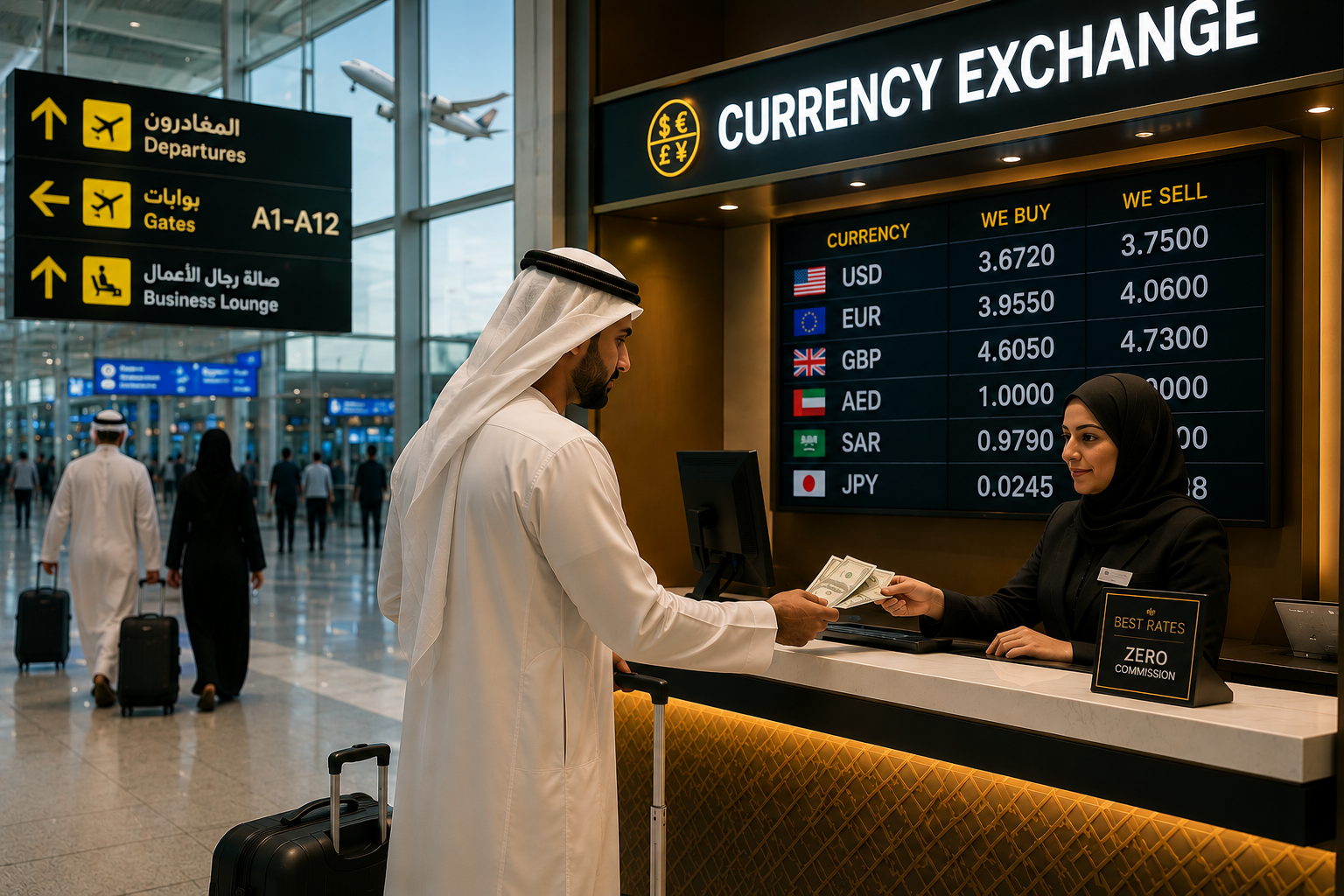
Every terminal seems to have one: staffed, well-lit, and open when nothing else is. They're also, in most cases, among the most expensive ways to exchange money.
That's not automatically a mistake. Arriving with no local currency and needing cash for a taxi is a reasonable use of a small airport exchange. The real mistake is converting large sums there when better options exist.
Better Alternatives to Airport Exchange
A practical approach for most travelers: carry a small amount of local currency before departure, then draw the rest from an ATM at the destination or a travel-capable bank card. ATMs on global networks tend to land closer to the market reference rate, though your own bank's fees and the local ATM's surcharge can still apply. Ordering foreign currency through your bank or a reputable online platform ahead of travel can also beat airport rates. For GCC-based travelers, exchange houses in the UAE, Saudi Arabia, and Oman generally offer competitive rates on popular corridors, especially USD, EUR, GBP, and South Asian currencies.
Small Habits, Real Savings
The travelers who come out ahead on this aren't currency experts. They just check the reference rate before a transaction, keep the exchanged-cash amount small, and use a card built for travel instead of a default one.
Building a Travel Budget That Accounts for Exchange Rate Risk
Most travel budgets are built on a fixed assumption: one exchange rate, locked in at planning time. That's understandable, but it introduces a risk seasoned travelers learn to manage.
A practical fix is a modest buffer, often 5%–10% above your calculated costs, to absorb rate movement between planning and payment. That's not excess caution; it reflects the reality that your actual home-currency cost can land a little higher than projected. On a trip budgeted at AED 10,000, for example, a 7% buffer sets aside an extra AED 700, enough to absorb a run of unfavorable hotel and card conversions without derailing the rest of the plan.
Using a Travel Budget Calculator
A currency-aware budget calculator is genuinely useful here. Rather than relying on one fixed rate, it lets you estimate spending in the local currency and see the home-currency equivalent more clearly. Planning a trip from the Gulf to Europe, South Asia, or anywhere with its own currency, pair the AllOverBooking Trip Budget Calculator with the live currency converter for a more realistic picture of the total cost.
Plan Your Travel Budget with Live Currency Awareness
Before booking flights, hotels, transfers, or tours, check your key exchange rate and calculate your expected travel budget in the currency you actually earn and spend.
Use the Trip Budget CalculatorThe Most Common Currency Exchange Mistakes Travelers Make
Understanding exchange rates is one skill. Avoiding the traps that catch even experienced travelers is another.
Exchanging Too Much Cash Too Early
Carrying a large amount of exchanged cash creates risk: loss, theft, and the hassle of returning unused currency. Exchange incrementally and lean on cards for most spending.
Ignoring the Total Cost of a Transaction
The rate alone doesn't tell the full story. A provider with an attractive rate but a flat fee can end up costing more than a competitor with a slightly weaker rate and no fee. Compare the total amount received, not the headline number.
Accepting Dynamic Currency Conversion
When a terminal abroad asks whether to pay in your home currency or the local one, choose local. Dynamic currency conversion is usually priced worse than your own bank's conversion.
Assuming All Exchange Providers Are the Same
They aren't. A bank, an airport counter, an online platform, and a specialist currency house can differ by several percentage points on the same transaction.
How Inflation and Exchange Rates Work Together, and Against You
Exchange rates and inflation are closely related, though not identical. A country with high inflation tends to see its currency weaken over time as purchasing power declines, and that matters for travelers in both directions.
Traveling to a country with high domestic inflation, local prices can rise faster than the exchange rate adjusts, so a destination that looks affordable purely on the exchange rate can turn out pricier once current local prices are accounted for. For remittance senders, inflation in the recipient country is a separate concern: sending the same amount every month may not preserve the same standard of living for family back home even when the exchange rate itself hasn't moved.
GCC Travelers and the Currency Advantage
Travelers from the Gulf Cooperation Council, the UAE, Saudi Arabia, Oman, Qatar, Kuwait, and Bahrain, operate with a structural advantage worth understanding. The UAE Dirham has held a fixed peg to the US Dollar since 1997, at roughly AED 3.6725, and the Saudi Riyal has held its own long-standing Dollar peg; both central banks have repeatedly reaffirmed the policy rather than signaled any change.
That stability carries through to purchasing power for Dollar-denominated expenses: international hotel chains, airline tickets priced in USD, and many globally priced luxury goods all move less erratically for Gulf-based travelers than they would for someone earning in a freely floating currency.
Popular Travel Corridors from the Gulf
The most active financial corridors from the Gulf reflect both tourism and the region's expatriate workforce. India, Pakistan, and Bangladesh collectively account for millions of Gulf-based workers, and corridors such as AED to INR, SAR to PKR, USD to BDT, and OMR to PKR are watched closely by travelers and families alike. Understanding live rates on these corridors before booking or transferring is good financial practice; even a modest improvement in timing on a significant transfer can mean real purchasing power on the receiving end.
The Qatari Riyal and Kuwaiti Dinar follow related but distinct arrangements of their own, the Kuwaiti Dinar in particular floats against a basket of currencies rather than a single Dollar peg, so its rate against the Rupee, Rupiah, or Peso moves somewhat independently of what the AED or SAR does on any given day. Travelers and remittance senders based in Kuwait should check their specific corridor directly rather than assuming it tracks the Dirham or Riyal one-for-one.
Practical Travel Planning Tips: Using Exchange Rate Awareness Wisely
Knowing that exchange rates matter is step one. Using that knowledge without obsessing over every small move is the actual skill.
- Check the mid-market reference rate for your key currency pair before any major exchange or booking.
- Compare at least two or three providers before converting a significant amount.
- Use a travel-friendly card or prepaid travel card for most spending abroad.
- Pay in local currency whenever a card terminal gives you the choice.
- Build a 5%–10% buffer into your travel budget to absorb currency movement.
- For remittances, compare the final received amount, not only the headline rate.
- Save large-sum exchanges for a bank or online platform; airport counters are for small emergency cash only.
- On long trips, a fixed travel money card can simplify budgeting considerably.
Verdict: What Matters Most by Traveler Type
There's no single "best" way to handle currency on a trip. The right habits depend on who you are and what you're actually doing with your money abroad.
- Leisure traveler on a single international trip
- Carry a small amount of local cash for arrival, pay by card in local currency everywhere else, and build a 5%–10% buffer into your budget.
- GCC worker sending money home monthly
- Check the live mid-market rate before each transfer and compare the final received amount across two or three providers rather than accepting the default.
- Frequent business traveler
- A fintech travel card with a low, transparent FX margin removes most of the guesswork and keeps expense reports predictable.
- Budget-conscious backpacker on a long trip
- A single travel money card, used consistently, is usually simpler and cheaper than juggling cash exchanges across multiple countries.
Currency Exchange Rates for Travelers: Frequently Asked Questions
Rates and Timing
How do I find the real exchange rate before traveling?
Start with the interbank or mid-market reference rate on a live currency converter for your specific pair, then compare that number against what a bank, exchange shop, card provider, or transfer app is actually offering you.
Is it better to exchange money before traveling or at the destination?
A balanced approach works best for most travelers: exchange a small amount before departure for immediate needs, then draw the rest from a local ATM, bank card, or trusted exchange provider once you arrive. Avoid converting large sums at an airport.
Why does the airport exchange rate differ from the rate shown online?
Airport counters sit in high-convenience locations where travelers often have little time and few alternatives, so their margins and fees typically run higher than online reference rates or competitive exchange providers.
Fees and Providers
Do exchange rates affect hotel and flight prices the same way?
Not quite. Hotel prices listed in a foreign currency move directly with the exchange rate at the time of payment. Flight prices are more layered, since airlines also adjust fares for demand, route, timing, and fuel costs on top of any currency effect.
How much can a travel-friendly card actually save compared to a standard bank card?
On a $3,000 international trip, a standard bank card charging roughly 3% plus ATM fees can run $90–$125 in currency-related costs. A fintech travel card with a 0%–0.6% margin typically lands closer to $5–$24 on the same spending, a difference of $70 or more on one trip alone.
How do remittance exchange rates work for Gulf workers?
The provider applies its own rate and fees when you send money from the Gulf to South Asia or elsewhere. The real cost is the gap between the market reference rate and the rate you actually receive, plus any stated transaction fee on top.
GCC-Specific Questions
Are the AED and SAR still pegged to the US Dollar?
Yes. The UAE Dirham has held its fixed peg near AED 3.6725 to the Dollar since 1997, and the Saudi Riyal maintains its own long-standing Dollar peg. Both central banks have repeatedly confirmed the policy is staying in place.
How can I protect my travel budget from exchange rate swings?
Build a modest buffer into your budget, pay in local currency wherever a terminal offers the choice, compare providers before any large exchange, and carry a travel-friendly card with a transparent, competitive FX margin.
How We Verified This Guide
Live AED-to-INR and SAR-to-PKR rate figures, exchange-house quotes, and interbank ranges were checked against dedicated currency-tracking sites reporting September 11, 2026 data. Remittance corridor cost figures for the AED-to-India route were checked against a World Bank remittance-cost survey cited on a UAE transfer-comparison site. Standard bank card and fintech travel card FX fee figures were checked against a dedicated card-fee comparison guide. The UAE Dirham's Dollar peg was checked against the UAE central bank's own published policy statement.
Sources: AED to INR live rate and exchange-house quotes via remit.ae; SAR to PKR interbank rate via hamariweb.com; USD to BDT rate via calculatorcafe.com; card FX fee comparison via tripprof.com; AED-USD peg policy via centralbank.ae.
Editorial note: This guide is written for travel planning and currency awareness, not financial, trading, or investment advice. Exchange rates, fees, and provider terms change quickly, so confirm the current rate before making any payment or transfer.
Continue Planning Your Trip
Check Live Currency Rates Before You Travel
Use AllOverBooking's free currency converter to compare key travel and remittance currencies before booking, exchanging, or sending money.
Use Free Currency Converter →