Airport Currency Exchange vs Local Exchange Rates: What Travelers Need to Know
The gap between what airport currency desks charge and what you would pay almost anywhere else is not small. Understanding this difference, especially before you are standing in a terminal with a flight to catch, is one of the most straightforward ways to protect your travel budget.
Why Airport Currency Exchange Rates Are Usually Higher
Airport exchange counters operate in what economists call a captive market. Once you are inside a terminal, your options for comparison shopping collapse dramatically. There is no walking down the street to find a better rate. You have a flight to catch, unfamiliar surroundings, and probably a queue forming behind you.
Exchange providers know this. The margins they apply at airport locations reflect the operational reality of premium retail space, staffing costs, and critically, limited competition. A traveler at an airport counter has fewer alternatives and less time than a traveler who planned their exchange a week in advance. That pricing asymmetry is baked into the rate you are offered.
How Much More Expensive, Exactly?
Airport currency exchange counters typically apply a margin of 5% to 12% above the interbank rate, which is the benchmark rate at which banks trade currencies in bulk. In busy international airports, it is common to see margins at the higher end of that range.
On a modest exchange of AED 2,000, a 7% margin means losing roughly AED 140 to the exchange rate alone, before any stated service fees. On larger amounts, such as a family exchanging travel money for a two-week trip, the loss compounds quickly.
Worth knowing: The margin is often invisible at the counter. The rate displayed may look reasonably close to what you have seen online, but the comparison point matters. Always check the interbank rate first using a live currency converter, as that is your real benchmark, not the rate at the counter down the hall.
Airport Exchange Counters vs Local Currency Exchange Shops
The comparison between airport exchange counters and high-street or city-based exchange shops is stark in most cases. Local exchange providers, including licensed shops in commercial areas, bank branches, or specialist currency exchanges, operate in a competitive environment where customers can compare and walk away.
That competitive pressure translates into meaningfully better rates. A licensed exchange shop in Dubai, Muscat, or Riyadh offering a commonly traded corridor like AED to PKR or SAR to PKR will typically come within 1% to 2% of the interbank rate. An airport counter for the same transaction may charge 6% to 8% more than the interbank rate, and the transaction is identical.

What to Look for in a Local Exchange Shop
- Licensed and regulated: only use exchange houses that display official licensing from the relevant financial authority in your country.
- Transparent rate display: reputable shops post buying and selling rates clearly. If a shop is vague about the rate before you hand over your money, walk out.
- Total received, not just the rate: ask for the exact amount you will receive in destination currency on your specific sum. Some providers apply flat service fees on top of the spread. The only number that matters is what lands in your hand.
- Compare two or three providers: in any major Gulf city, there are multiple licensed exchange houses within a short distance of each other. Two minutes of comparison often produces a noticeably better result.
| Exchange Method | Typical Margin Above Interbank | Rating |
|---|---|---|
| Airport exchange counter | 5% to 12% | Poor |
| Hotel desk | 6% to 10% | Poor |
| Standard bank branch | 2% to 4% | Moderate |
| Local exchange shop (Gulf) | 1% to 2.5% | Good |
| Online exchange platform | 0.5% to 2% | Good |
| ATM at destination (global network) | 1% to 3% + fixed fee | Good |
| Travel credit card (no FX fee) | 0% to 1% | Best |
Hidden Fees Travelers Often Ignore
The exchange rate is only one part of the cost equation. Several additional charges frequently catch travelers off guard, not because they are hidden in a legal sense, but because they are easy to overlook when you are focused on the headline rate.
Service Fees and Commission Charges
Many airport counters and some bank branches charge a flat commission on every exchange transaction, sometimes stated as a fixed amount and sometimes as a percentage. A counter offering a marginally better rate but charging a commission of AED 20 or USD 5 per transaction may be more expensive overall than a competitor with a slightly wider spread but no commission. Always ask for the total before committing.
Foreign Transaction Fees on Cards
If you are using a standard debit or credit card to pay abroad, your bank likely applies a foreign transaction fee on every overseas purchase, typically 1.5% to 3.5% of the transaction value. This is separate from the exchange rate margin and is charged in addition to it. On a week of card spending, this adds up to a real and recurring cost.
Travel-specific cards, now offered by many UAE, Saudi, and Omani banks, eliminate this fee and apply exchange rates closer to the interbank rate. If you travel internationally more than once a year, carrying one is a straightforward decision.
Dynamic Currency Conversion
This is the most misunderstood fee in international travel. When a card terminal abroad asks whether you would like to pay in your home currency or the local currency, it is offering something called dynamic currency conversion (DCC). It sounds convenient because you can see the familiar currency, but the conversion rate applied is set by the merchant or terminal operator, not your bank, and it is consistently worse.
Always choose local currency. When paying by card abroad, selecting your home currency at the terminal locks in a rate the merchant controls. Choosing the local currency lets your card issuer handle the conversion, almost always at a better rate. This applies to ATMs too: always decline the offer to convert to your home currency.
Should Travelers Exchange Currency Before Flying?
In most situations, yes, at least for the amount you will need immediately upon arrival. Exchanging currency before departure gives you access to a wider range of providers, more time to compare rates, and the ability to use competitive options like local exchange houses or online platforms.
A practical approach that works for most international travelers:
- Exchange a modest amount before departure: this is enough for ground transport, a meal, and any first-day incidentals. This covers you from the moment you land without overcommitting to a large exchange.
- Use a travel card or ATM for the bulk of your spending: you can load a travel money card with a fixed amount at a competitive rate before you leave, or withdraw from ATMs at your destination using a fee-aware strategy.
- Avoid the airport counter for large sums: if you realize you need more currency after arriving, a city-centre exchange shop or ATM will almost always offer a better rate than the airport counter.
For travelers planning a trip from the Gulf, combining currency preparation with broader trip planning tools like a trip budget calculator lets you model your destination spending in real-time exchange rate terms before you commit to anything.
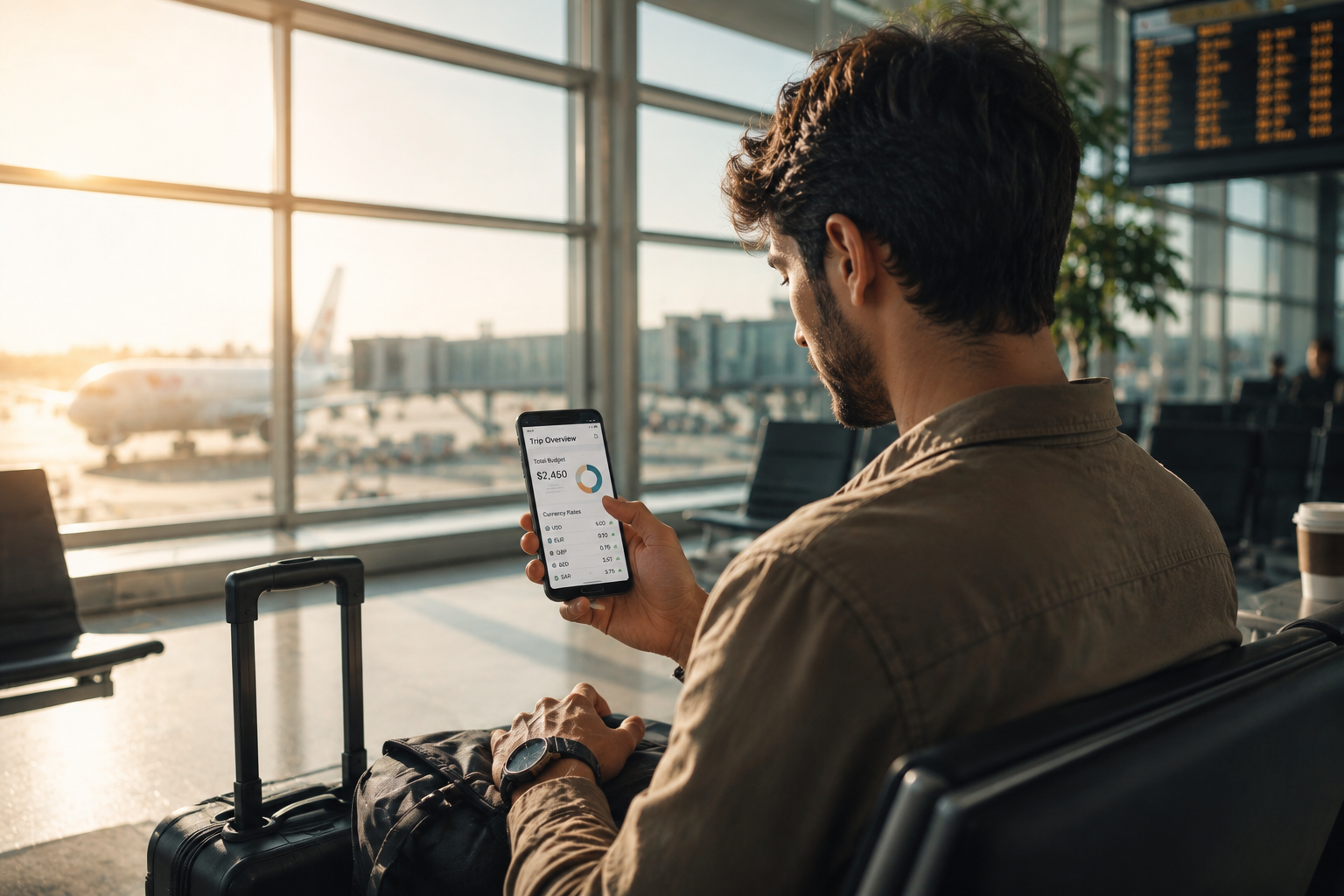
Airport ATM vs Currency Exchange Counter
When you are already at the airport and need local currency, the question shifts from "should I exchange here?" to "which airport option is less bad?" The comparison between the airport ATM and the currency exchange counter is worth understanding.
Airport ATMs: Closer to a Fair Rate
ATMs connected to global networks, such as Visa and Mastercard, typically apply exchange rates much closer to the interbank rate than airport counters. The rate is set by your card's network, not the ATM operator, which removes a significant layer of margin.
The catch is fixed fees. Many banks charge a flat fee for international ATM withdrawals, often AED 15 to 30 or the equivalent, regardless of the amount withdrawn. If you are withdrawing a small sum, this fee represents a disproportionate percentage cost. Withdraw enough to cover several days of spending in one transaction to minimize this per-unit cost.
Currency Exchange Counters: Convenient, Not Competitive
Airport exchange counters apply the widest margins in the market, as covered above. They also tend to charge additional service fees in many international airports. The only scenario in which an airport counter makes sense is when you need a small amount of cash immediately and the ATM queue is long or the machine is out of service.
Airport ATM vs Exchange Counter: Quick Comparison
- Rate quality: ATM typically 2% to 4% above interbank; counter typically 5% to 12% above interbank
- Fees: ATM has fixed per-withdrawal fee; counter may have both spread and service fee
- Best use: ATM for amounts of AED 300 or more equivalent; counter only for genuine emergencies
- Key rule: Always decline dynamic currency conversion at any airport ATM
Best Currency Exchange Strategies for GCC Travelers
Travelers and overseas workers based in the Gulf have some structural advantages worth using. Gulf currencies, including the AED, SAR, OMR, and others, are pegged to the US Dollar, which provides stability and often favourable purchasing power in destinations where currencies have weakened against the dollar.
Licensed Exchange Houses: Your Best Starting Point
The Gulf has one of the most developed retail foreign exchange ecosystems in the world. Licensed exchange houses, which are regulated by the relevant central bank, are widespread and competitive, particularly for high-volume corridors like OMR to PKR, AED to PKR, and USD to PKR.
For popular corridors, these exchange houses typically offer rates within 1% to 2% of the interbank rate. Comparing two or three providers before a significant exchange takes less than ten minutes and usually produces a meaningfully better outcome.
Rate Alerts: A Simple Tool Most Travelers Don't Use
Many banking apps and currency platforms now offer rate alert functionality. You set a target rate for a specific currency pair, and the app notifies you when it is reached. For regular remittance senders or travelers planning a large exchange, this removes the need to monitor manually and ensures you act at a favorable moment rather than an arbitrary one.
Travel Cards for International Spending
Loading a travel money card with a fixed amount in your destination currency before departure locks in the current rate and removes the uncertainty of rate movement during your trip. For travelers to Europe, for instance, loading a fixed Euro balance at a competitive pre-travel rate avoids exposure to daily fluctuations during your stay.
GCC traveler tip: If you are flying internationally, whether for leisure, business, or visiting family, build your currency planning into your pre-departure checklist alongside flights and accommodation. Checking flight options and exchange rates together gives you a complete cost picture before you commit.
Common Currency Exchange Mistakes International Travelers Make
These are the patterns that reliably cost travelers money, not through complexity or bad luck, but through avoidable habits that are easy to change once you are aware of them.
1. Waiting Until the Airport
This is already covered in detail above, but it bears repeating because it remains the single most costly and most common mistake. The traveler who realizes they need local currency at the departure terminal has already eliminated their best options.
2. Accepting the First Rate Offered
Many travelers accept the first exchange rate they are shown without comparison. In a Gulf city, walking into the nearest exchange house and accepting whatever rate is displayed is like buying airline tickets from the first search result without checking alternatives. Two or three minutes of comparison almost always produces a better result.
3. Ignoring the Total Cost
Focusing on the headline exchange rate and ignoring service fees, commission charges, or minimum transaction requirements is a common miscalculation. A provider with a slightly less favorable rate but zero fees may offer a better total outcome than one with an attractive rate and a flat AED 25 charge.
4. Converting Leftover Currency Carelessly
Returning from a trip with significant leftover foreign currency and exchanging it at the first available counter, often an airport on the way home, compounds the cost of the original exchange mistake. If you have leftover currency, compare providers before converting, or hold it if you plan to return to the same destination.
5. Using a Standard Card for Everything Abroad
A standard bank card with a 2.5% foreign transaction fee applied to every overseas purchase is a quiet but consistent drain on your travel budget. The fix is simple: apply for a travel card that waives this fee. Many major Gulf banks offer these; the difference across a week of spending is real money.
How Exchange Rates Affect Overall Travel Costs
Currency is not just a logistical detail. It is one of the most significant variables in what your trip actually costs. A destination that appears affordable in brochure terms can become expensive in practice if exchange rates shift unfavorably between planning and travel. The reverse is also true: destinations can become more accessible when your home currency is performing well.
Hotels and Accommodation
International hotel chains often price rooms in USD or EUR. If you are booking from the Gulf and paying in AED or SAR, the exchange rate applied at the time of payment or at checkout determines your real cost. A rate shift of 3% to 4% on a ten-night hotel stay is the equivalent of an extra night's accommodation gone silently.
Selecting payment in the local currency of the property, rather than accepting dynamic currency conversion to your home currency, ensures your bank handles the conversion, generally at a more competitive rate than the hotel's system applies.
Dining, Transport, and Day-to-Day Spending
Daily spending, including restaurants, transport, local markets, and activities, adds up across the duration of a trip and is entirely subject to the exchange rate in effect when each purchase is made. Travelers using a card with no foreign transaction fees and selecting local currency at every point of sale absorb these costs at competitive rates automatically, without needing to monitor anything actively.
Using a trip budget calculator that incorporates live exchange rates before departure gives you a realistic picture of daily spending in your home currency, which is genuinely useful for setting spending limits and avoiding end-of-trip budget surprises.
Remittances and the Long-Term Impact
For overseas workers sending money home regularly, the exchange rate is not a one-time consideration but a recurring financial factor. The SAR to PKR or AED to INR rate on the day of each transfer determines how much reaches the family at the other end. Over twelve months of monthly transfers, even a 1% to 2% consistent rate improvement compounds into a meaningful real-world difference.
Practical Ways to Save Money While Traveling Internationally
The cumulative impact of small, intentional currency decisions across a trip is larger than most travelers expect. Here are the habits that make the most consistent difference.
- Check the interbank rate first. Before any exchange at a shop, a bank, or an airport, spend thirty seconds looking up the live mid-market rate. That is your benchmark for evaluating any offer.
- Pay in local currency, always. At card terminals and ATMs abroad, always select the local currency option. This single habit eliminates dynamic currency conversion charges across an entire trip.
- Use a fee-free travel card. Carry a travel-specific card with no foreign transaction fees for most spending abroad. Use it as your primary card and keep a small amount of local cash for situations where cards are not accepted.
- Consolidate ATM withdrawals. If using an ATM abroad, withdraw enough for several days in one visit. Fixed withdrawal fees make frequent small withdrawals disproportionately expensive.
- Compare before you exchange. For any sum worth exchanging, such as AED 500 or more or its equivalent, check two or three providers. In most Gulf cities, this takes under ten minutes and consistently produces a better rate.
- Plan currency alongside the rest of your trip. Use tools like the trip planner and trip budget calculator to integrate currency planning into your overall trip preparation rather than as an afterthought at the terminal.
- Do not rush the exchange decision. Deadline pressure at an airport is exactly when exchange providers make the most money. Avoid it by completing the bulk of your exchange before you arrive at the departure point.
Final Expert Recommendations for Smart Travelers
There is no single perfect approach to currency exchange that works identically for every traveler in every situation. But there is a consistent framework that reliably produces better outcomes than the default.
The Smart Traveler's Currency Framework
- Check the interbank rate before any exchange, as it is your benchmark, not the rate on the counter display
- Exchange a modest amount at a local exchange house or online platform before departure
- Use a travel card or fee-free credit card for the majority of in-trip spending
- Withdraw larger amounts from ATMs less frequently; always decline DCC
- Set a rate alert if you are planning a significant exchange or transfer in the coming weeks
- For remittances, compare the total amount received across multiple providers, not just the headline rate
- Reserve airport exchange for genuine last-minute emergencies only
The most useful shift is simply treating currency as part of your travel planning rather than a logistical detail you handle at the terminal. Fifteen minutes of preparation before departure routinely saves more than the cost of a dinner out, and that is not a small thing.
For live rates on the corridors that matter to you, whether that is AED to PKR, EUR to USD, or any other pair, the AllOverBooking currency converter gives you the interbank benchmark alongside the tools you need to plan the full trip.
Editorial note: This guide is written for practical travel planning and currency awareness. Exchange rates shown by banks, airport counters, ATMs, and exchange shops can differ from live reference rates because of spreads, fees, and provider policies. Always confirm the final amount before completing a transaction.
Frequently asked questions
Why are airport currency exchange rates so much worse than local rates?
Airport exchange counters operate in a captive market where travelers have limited alternatives, limited time, and limited ability to compare. Providers take advantage of this environment by applying wider margins, typically 5% to 12% above the interbank rate, and charging additional service fees. The convenience of location is priced into the rate you receive.
Is it better to use an ATM or a currency exchange counter at the airport?
An ATM connected to a global network, such as Visa or Mastercard, is almost always a better option than the exchange counter. ATMs apply rates closer to the interbank rate, whereas counters add a significant spread on top. The main cost of an ATM is a fixed withdrawal fee, which you minimize by withdrawing a larger amount in one visit. Always decline the dynamic currency conversion option at foreign ATMs.
When is the best time to exchange currency before traveling?
Two to four weeks before departure is a practical and commonly effective window for most travelers. This gives you enough time to monitor rates and act on a favorable moment without the pressure of an imminent flight. For regular remittance senders, setting a rate alert for your specific corridor allows you to act when the rate reaches a target level rather than monitoring constantly.
What are foreign transaction fees and how do I avoid them?
Foreign transaction fees are charges applied by your bank on every overseas card purchase, typically 1.5% to 3.5% of the transaction amount. They are charged in addition to the exchange rate margin. The most straightforward way to avoid them is to use a travel-specific credit or debit card that waives this fee. Many Gulf banks now offer such cards. For occasional travelers, the savings across a single trip can be significant.
How can I build currency exchange costs into my international travel budget?
Start by checking the live interbank rate for your key currency pair. This tells you what your destination spending will cost in home-currency terms at current conditions. Add a 5% to 10% buffer to account for exchange rate movement during your trip. Use a trip budget calculator that incorporates live rates to model total trip costs before departure. The closer your planning uses real exchange rate data, the fewer surprises you will encounter on the ground.