AllOverBooking • Travel Finance Guide
Best Ways to Avoid Hidden Currency Conversion Fees While Traveling
Every year, international travelers collectively lose billions of dollars to fees they never saw coming. Not from scams — from the ordinary act of spending money abroad. Currency conversion charges lurk inside ATM receipts, credit card statements, and merchant terminals in ways that are perfectly legal but rarely explained at the point of payment.
If you've ever returned from a trip and noticed your card statement looked noticeably higher than what you actually spent, hidden currency conversion fees were almost certainly involved. The good news: once you understand where these charges come from, most of them are entirely avoidable.
This guide breaks down every layer of the problem — and gives you practical tools to stop the leakage.
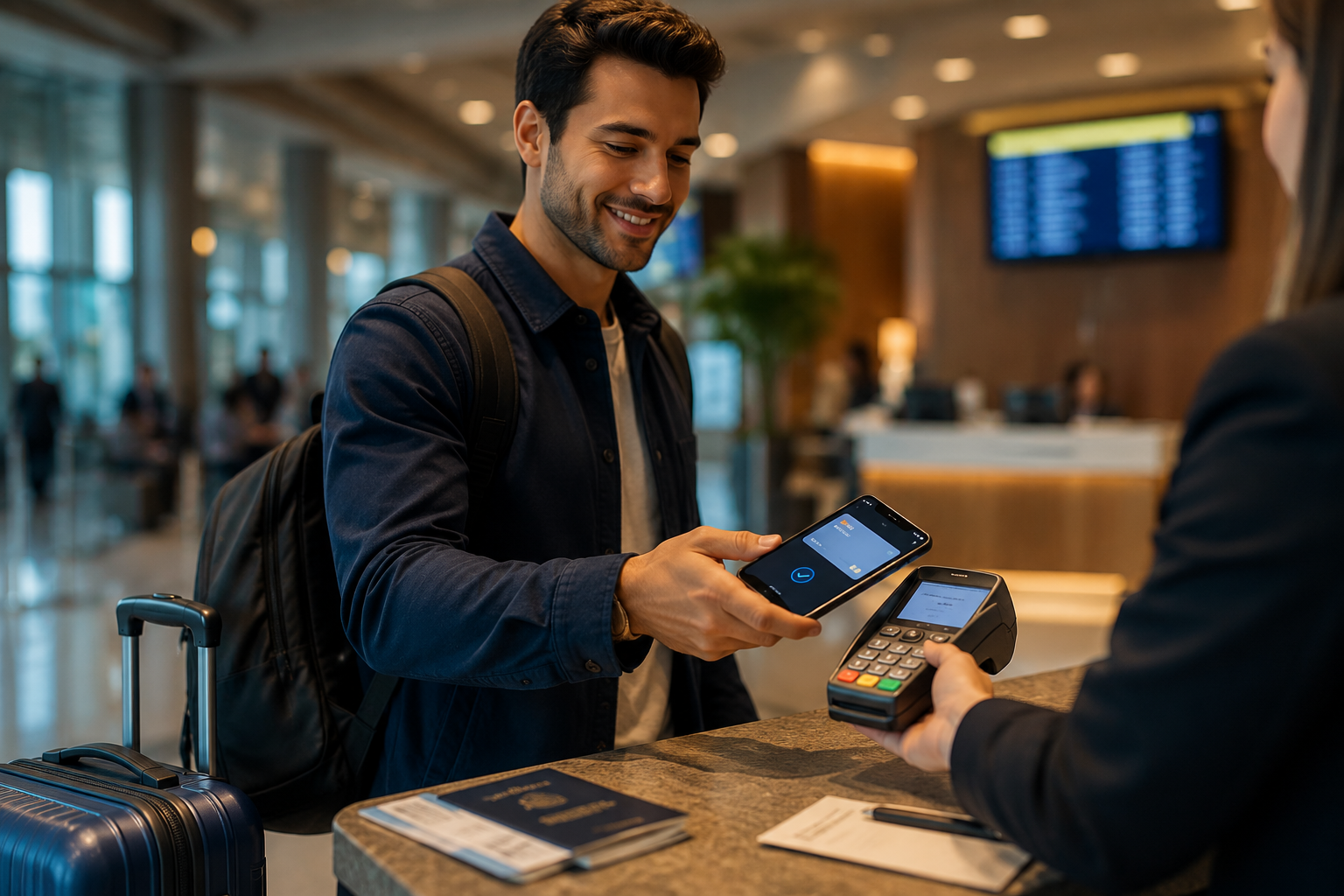
A traveler uses a smartphone payment app at an airport counter before an international journey.
What Hidden Currency Conversion Fees Actually Are
The term "hidden" doesn't necessarily mean illegal or concealed. It refers to charges that aren't displayed clearly at the moment you pay — or that are buried in fine print most travelers never read.
Currency conversion fees fall into a few distinct categories:
- Exchange rate markup: The spread between the real interbank rate and the rate you're offered. This is how most banks and exchange bureaus profit.
- Foreign transaction fees: A fixed percentage (typically 1.5%–3.5%) applied by your card issuer on any international payment.
- Dynamic currency conversion (DCC) charges: A fee embedded when a merchant converts the price to your home currency instead of the local one.
- ATM operator fees: Charged by the foreign ATM provider, separate from whatever your home bank charges.
- Airport exchange commission: A service fee on top of an already-unfavorable rate at airport currency counters.
Each of these can be small on its own — 1% here, 3% there. But across a two-week trip with daily card use, they compound into real money.
Why Travelers Lose Money Without Realizing It
The psychology here is straightforward: when you're focused on your destination, fees feel abstract. You're thinking about the hotel, the itinerary, the experiences. A 2.5% surcharge on a dinner doesn't register the way a visible $15 fee would.
Banks and payment processors know this. The charges are structured to feel invisible — they don't appear as line items during the transaction. They show up later, in a monthly statement, far removed from the emotional context of the purchase.
A Real-World Example
Consider a traveler from the UAE visiting Europe for 10 days. They spend roughly AED 1,500 per day using a standard debit card. Their bank charges a 2.5% foreign transaction fee. They also use local ATMs twice, each with a combined fee of AED 25. And at one restaurant, they agree to pay in AED instead of euros — triggering a DCC markup of around 4%.
By the end of the trip, they've paid close to AED 600 in fees alone. That's nearly half a day of their budget, gone — not to experiences, but to financial infrastructure.
Airport Exchange Fees Explained
Airport currency exchange desks are convenient by design. They're positioned exactly where travelers are most anxious, most rushed, and least likely to compare rates. That convenience comes at a steep cost.
Most airport exchange counters offer rates that are 8%–15% worse than the interbank rate — the rate banks use when trading with each other. A traveler exchanging OMR 500 at an airport desk could lose OMR 40–75 compared to what a proper bank transfer or specialist exchange service would offer.
On top of the rate markup, many airport desks charge a commission fee — sometimes flat, sometimes percentage-based — that isn't always displayed prominently.
When Airport Exchange Is Unavoidable
If you land with no local currency and need cash immediately — for a taxi, a sim card, a local bus — exchange the minimum amount needed. Get just enough to reach your accommodation or the nearest bank ATM. Then exchange the rest through a better channel.
Before flying, use a real-time currency converter to understand what a fair rate looks like. If the airport desk is offering something dramatically lower, you'll recognize it immediately rather than assuming it's normal.
For a deeper look at how airport rates compare to local exchange options, this airport vs local exchange rates guide breaks down the numbers across popular travel corridors.
Dynamic Currency Conversion (DCC) Explained
Dynamic currency conversion is one of the most misunderstood — and most costly — traps in international travel finance. It happens at the point of sale, when a merchant's payment terminal detects that your card is from a foreign country and offers to convert the amount into your home currency.
It sounds helpful. It isn't.
When a merchant converts the charge, they use their own exchange rate — which typically carries a 3%–7% markup above the market rate. Your card issuer would have converted it too, but usually at a more favorable rate (even accounting for their own fees).
How DCC Gets Triggered
- A restaurant in London asks: "Would you like to pay in British pounds or UAE dirhams?"
- A hotel in Thailand presents a bill already converted to Saudi riyals.
- An ATM abroad offers to "convert for you" before dispensing cash.
In each case, the correct answer is to pay in the local currency. Always. The merchant's conversion rate is almost never in your favor, and there is no regulatory requirement for them to disclose the markup percentage before you agree.
Why Paying in Local Currency Is Usually Better
When you choose local currency at payment, your card network (Visa, Mastercard, or similar) handles the conversion using the mid-market or near-mid-market rate. This is typically far more competitive than what a local merchant or ATM operator will apply.
Your bank may still charge a foreign transaction fee — but that fee is usually lower than the DCC markup. And with the right travel card, even that disappears entirely.
The Practical Rule
Whenever a terminal, ATM, or cashier asks whether you want to pay in your home currency or the local currency: choose local. This single habit, applied consistently, can save a meaningful percentage of your trip spending.
ATM Withdrawal Fees Abroad
Using an ATM abroad involves a layered fee structure that catches many travelers off guard. There are typically two separate charges involved:
- Your home bank's international ATM fee: A flat fee or percentage applied every time you use a non-network ATM abroad. Common rates range from $2–$5 per transaction, or 1%–3% of the withdrawal amount.
- The foreign ATM operator's fee: The machine itself may charge an additional fee for providing access to your funds. This is separate from your bank's charges and varies widely by country and provider.
A $5 flat fee on a $50 withdrawal is a 10% charge before any rate markup. A $5 fee on a $300 withdrawal is under 2%. The practical takeaway: withdraw larger amounts less frequently, rather than small amounts often.
Finding Better ATMs Abroad
Not all ATMs are equal. ATMs attached to major local banks usually offer better rates and lower fees than standalone machines in tourist areas, airports, or hotel lobbies. In GCC countries and across Southeast Asia, tourist-district ATMs are often the most expensive option in the city.
Look for ATMs affiliated with major local banks in commercial districts. Withdraw during banking hours so you can resolve any issues immediately if something goes wrong.
| Fee Type | Where It Appears | Best Way to Avoid It |
|---|---|---|
| Dynamic Currency Conversion | Card terminals and ATMs | Always choose local currency |
| Foreign Transaction Fee | Bank card statement | Use a no-foreign-fee travel card |
| ATM Operator Fee | Foreign ATM screen | Use bank ATMs and withdraw larger amounts less often |
| Airport Exchange Markup | Airport exchange counters | Use only for emergency small cash |
Foreign Transaction Fees on Debit and Credit Cards
Foreign transaction fees — sometimes listed as "international purchase fees" or "forex fees" — are applied by your card-issuing bank on transactions processed outside your home country. They typically range from 1.5% to 3.5% of the transaction value.
These fees apply even when you pay in your home currency through DCC, which means you can be double-charged: once by the DCC provider, once by your bank. This is the worst possible outcome of an international card payment.
Checking Your Card's Fee Structure
Before your next trip, find your card's fee schedule — usually available in your bank's app or online portal — and look specifically for:
- International transaction fee percentage
- ATM withdrawal fee (flat or percentage)
- Currency conversion markup (some banks add this on top of the base rate)
If your card charges more than 2% in combined foreign fees, it may be worth applying for a travel-specific card before your trip.
Best Travel Cards for International Spending
The travel card market has matured significantly in recent years. Several card products are specifically designed to eliminate or minimize the fees that standard bank cards impose on international transactions.
What to Look For
- No foreign transaction fee: This should be the baseline requirement.
- Mid-market exchange rates: Cards that convert at or near the interbank rate with no added markup.
- Free ATM withdrawals abroad: Some cards offer a monthly allowance of fee-free international withdrawals.
- Multi-currency accounts: Accounts that let you hold balances in multiple currencies and spend from the relevant one without conversion.
Card Types Worth Considering
Dedicated travel debit cards from fintech providers often offer mid-market rates, free international ATM withdrawals up to a monthly limit, and instant spending notifications. They tend to be more flexible than traditional bank accounts for currency management.
Travel-focused credit cards from major banks typically waive foreign transaction fees and offer competitive exchange rates. Some include travel insurance and purchase protection as added benefits.
Prepaid travel cards let you load currencies in advance at a locked-in rate — useful if you want certainty, though you lose the flexibility of spending in whichever currency is cheapest at the moment.
For GCC-based travelers — whether holding AED, SAR, or OMR — the card selection available through regional banks has improved considerably. However, the fee transparency varies. Always read the specific terms rather than assuming a "travel card" is automatically fee-free.
How to Check Real Exchange Rates Before Paying
The interbank rate — also called the mid-market rate or real exchange rate — is the baseline against which all commercial rates should be measured. It's available in real time through financial data providers and represents the true value of one currency against another.
Before any significant currency exchange or international purchase, check the mid-market rate using a reliable source. Then compare it to what you're being offered. The difference is the effective fee you're paying.
A traveler from Oman checking the OMR to USD rate before exchanging cash can immediately see whether an exchange desk's offer is competitive or exploitative. This 30-second check, done consistently, can prevent some of the most significant losses in travel finance.
The travel currency exchange rates guide covers how to interpret rate movements and identify the best windows for exchange — particularly relevant when rates are volatile.
Common Currency Conversion Mistakes Travelers Make
Most currency conversion losses aren't the result of one large mistake — they're the accumulation of small, repeated habits that each cost a little.
The Most Frequent Errors
- Exchanging at the airport on arrival without knowing the current mid-market rate
- Agreeing to DCC without realizing what it means
- Making frequent small ATM withdrawals instead of fewer larger ones
- Using a standard debit card abroad without checking its fee structure first
- Not notifying your bank of travel plans, leading to blocked transactions and emergency cash needs at airport counters
- Assuming "no commission" means a good rate — it doesn't; the markup is often built into the rate itself
- Returning home with large amounts of foreign cash and losing again on the reconversion
Each of these is fixable. Most require only a small shift in habit or a few minutes of preparation before the trip begins.
Best Ways to Reduce Currency Exchange Costs
Bringing together everything above, here's a practical framework for minimizing currency conversion costs on any international trip:
- Apply for a no-foreign-fee travel card before your trip. Use it as your primary spending card abroad.
- Always pay in local currency at merchants, restaurants, and hotels. Decline DCC every time.
- Check the mid-market rate before any cash exchange. Use the currency converter as your benchmark.
- Avoid airport exchange desks for large amounts. Exchange what you must, then use a bank ATM or local exchange bureau in the city.
- Withdraw cash strategically — fewer larger withdrawals to reduce per-transaction fees.
- Use city-center bank ATMs over tourist-area machines or hotel lobby ATMs.
- Monitor your spending against your trip budget using a trip budget calculator to catch fee accumulation early.
- Notify your bank of travel dates before departure to prevent card blocks.
- Spend down foreign cash before returning home. Reconversion costs add another layer of loss.
Smart Currency Exchange Tips for GCC Travelers
Travelers based in Gulf Cooperation Council countries — the UAE, Saudi Arabia, Oman, Kuwait, Qatar, and Bahrain — often travel frequently and to a wide variety of destinations. GCC currencies are generally pegged to the USD, which provides some stability, but it doesn't eliminate the fees embedded in international card use or foreign exchange.
UAE-Based Travelers
AED holders traveling to Europe, South Asia, or Southeast Asia should be particularly aware of DCC at payment terminals. Many merchants in tourist-heavy destinations will attempt DCC on UAE cards, knowing that foreign visitors are less likely to question it.
For those sending money or tracking cross-currency values — for example, checking AED to PKR rates — the same principle applies: always compare against the mid-market rate before committing to any transaction.
Oman and Saudi Travelers
OMR is one of the world's higher-valued currencies, which means transaction fees — expressed as percentages — can translate to notable absolute sums. A 3% foreign transaction fee on a 500 OMR purchase is 15 OMR, which is not a trivial amount.
For travelers tracking OMR to PKR or SAR to PKR rates — common for expatriates and frequent travelers across South Asian corridors — being aware of rate markups is particularly valuable given the volume of transactions involved.
Timing Your Exchange
Timing Your Exchange
Currency rates move constantly. For major trips involving significant currency conversion, timing your exchange to favorable rate windows can make a meaningful difference. Monitoring exchange-rate trends and setting up rate alerts can help travelers secure more competitive conversion rates and reduce overall travel costs.
Final Expert Recommendations for Travelers
The core insight from all of this is simple: currency fees are largely optional. They exist because most travelers don't know to avoid them. With a small amount of preparation — the right card, the right habits, and a basic understanding of how exchange rates work — the majority of these charges can be eliminated or dramatically reduced.
Before your next international trip:
- Audit your current card's fee structure. If it charges foreign transaction fees, consider a dedicated travel card.
- Bookmark a reliable mid-market rate source. Use it before any cash exchange.
- Learn to recognize and decline DCC. This one habit alone can save 3%–7% on every merchant transaction.
- Plan your ATM withdrawals. One or two strategic withdrawals beat six small ones.
- Use a trip planner that accounts for realistic spending, including an honest estimate of the fees you're likely to encounter based on your destination.
International travel is expensive enough without giving away money unnecessarily. Every dirham, riyal, or baisa saved on fees is a dirham spent on the trip itself.
Frequently Asked Questions
What is the difference between a foreign transaction fee and a currency conversion fee?
A foreign transaction fee is charged by your card-issuing bank on purchases made in a foreign country — typically 1.5%–3.5% of the transaction. A currency conversion fee (or exchange rate markup) is the spread between the real interbank rate and the rate applied to your transaction. Both can apply simultaneously, meaning you may be paying two separate fees on a single international purchase.
What is dynamic currency conversion, and should I always avoid it?
Dynamic currency conversion (DCC) occurs when a merchant or ATM converts your transaction into your home currency at the point of sale, instead of letting your card network handle the conversion. DCC rates almost always include a markup of 3%–7% above the market rate. In nearly all cases, you should decline DCC and choose to pay in the local currency — your card network's conversion, even with a foreign transaction fee, will typically be cheaper.
Are airport ATM fees higher than city ATMs?
Generally, yes. Airport ATMs — particularly those in international arrivals halls — tend to charge higher operator fees and offer less favorable exchange rates than ATMs operated by established local banks in city centers. If you need cash on arrival, withdraw the minimum required, then use a bank ATM once you reach your destination for larger amounts.
How can I find out what exchange rate my card is using?
Your card network (Visa, Mastercard) publishes the exchange rates they apply to international transactions on their websites. Compare this against the current mid-market rate using a real-time converter. Your bank may add an additional markup on top of the card network's rate — check your card's fee schedule for details. The difference between the mid-market rate and what your card applies is your effective conversion cost.
Is it better to exchange currency before traveling or when I arrive?
It depends on the destination and your timing. Exchanging before travel through your home bank or a specialist exchange service usually offers better rates than airport desks on arrival. However, in some destinations, local exchange bureaus in the city center offer very competitive rates. The key is to avoid airport counters for large amounts, compare against the mid-market rate regardless of where you exchange, and never assume the most convenient option is the best-priced one.